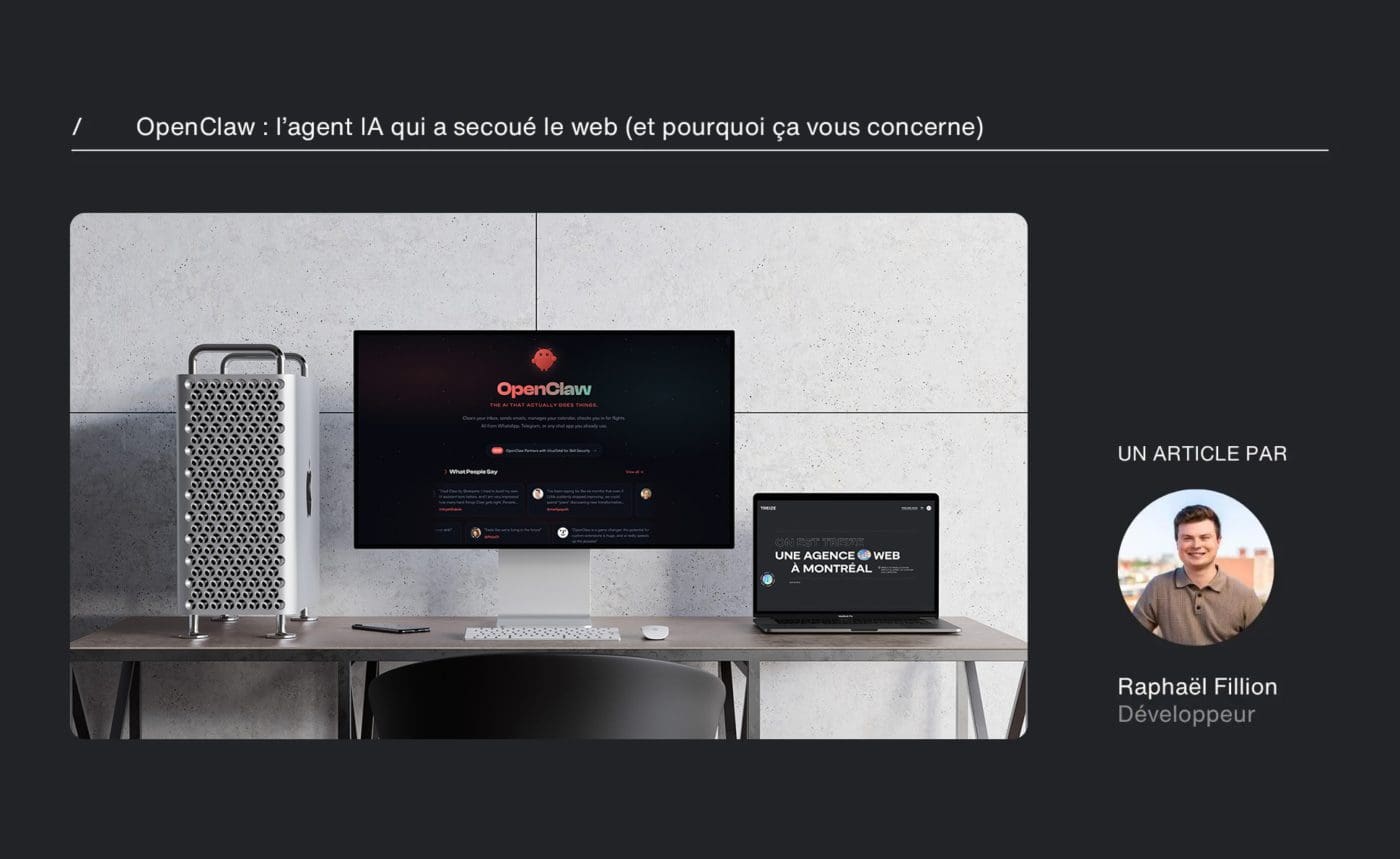
You may have seen “ClawdBot” pop up in your feed in recent weeks. If not, this open-source project, renamed OpenClaw, is redefining what we expect from an AI assistant. More than 100,000 GitHub stars in under a month, articles in CNBC, TechCrunch and WIRED, a creator hired by OpenAI… This is the most viral automation project since ChatGPT. And we wanted to understand why.
What is it, exactly?
OpenClaw is an open-source AI assistant that runs directly on your machine (a Mac, a Linux server, even a Raspberry Pi). Created by Austrian developer Peter Steinberger, it connects to your messaging apps (WhatsApp, Telegram, Slack, Discord, Signal…) and uses a language model (Claude, GPT, DeepSeek, etc.) to carry out real tasks on your computer.
We are not talking about a chatbot that rephrases your questions. We are talking about controlling an AI agent from your phone while you do something else. One user had OpenClaw negotiate the purchase of a car, and the tool contacted dealerships by email to get the best price. Another had it build a complete website via text messages from their phone (it probably was not as good as TREIZE’s). This is the kind of thing that raises questions on our end.
Memory that does not fail
What really sets OpenClaw apart from the assistants we know is its persistent memory. No need to explain everything again every session. It remembers your preferences, your files, your context from one exchange to the next. It can even schedule automated tasks, like a summary of your emails every morning at 8:00, set up via a cron. Think of it as an assistant in a company, but one that works 24/7 without breaks.
From ClawdBot to OpenClaw: three names in one week
At first, the project was called ClawdBot, a pun on Claude, Anthropic’s chatbot. And yes, the mascot is a lobster. On January 27, 2026, Anthropic sent a rebranding request, arguing that “Clawd” created too much confusion with “Claude.” What happened next feels like a movie plot. During the few seconds Steinberger was changing account names on GitHub and X (Twitter), crypto scammers jumped on the old handles to launch a fake $CLAWD token on Solana. Within hours, the token hit a $16 million market cap, before crashing 90% when Steinberger publicly called out the scam. The project briefly went by “Moltbot,” a name chosen at 5:00 AM on Discord with the community, before landing for good on OpenClaw.
The irony? The project that started as a tribute to Claude ended up… at OpenAI (ChatGPT).

A very real impact on the industry
The hype around OpenClaw has had very tangible effects. Delivery times for Mac mini and Mac Studio models with lots of memory went from a few days to several weeks. People are buying machines just to run the agent locally. Tom’s Hardware and TechRadar both covered the shortage, and Apple confirmed they are working to catch up with demand for memory chips.
On February 14, 2026, Steinberger announced on his blog that he was joining OpenAI to work on the next generation of personal agents. Sam Altman called him a “genius” on X, adding that the project would quickly become central to OpenAI’s product offering. OpenClaw will be transferred to an independent open-source foundation.
Risks to keep in mind
All of this is impressive. But rapid adoption also means blind spots. OpenClaw’s popularity has highlighted serious security issues.
Security researchers discovered hundreds of unprotected instances publicly accessible via Shodan, with API keys, bot tokens and conversation histories exposed. The main issue is that the authentication system automatically approves localhost connections (connections coming from your own machine), which, behind a reverse proxy, opens the door to anyone.
On the ecosystem side, ClawHub, the community skills registry, contained more than 300 compromised extensions (Trojans, data stealers, backdoors), according to analyses by VirusTotal and OpenSourceMalware. Steinberger has since set up a partnership with VirusTotal to scan extensions automatically.
API costs can also spiral quickly. Several Reddit posts with hundreds of upvotes reported hefty bills for just a few days of use.
Gartner has even called OpenClaw an “unacceptable cybersecurity risk” in its current form for enterprise use. It is a powerful tool, but it requires real technical expertise to deploy properly.
Why should we care?
OpenClaw is proof that AI is reaching a new milestone. We are no longer in the chatbot that rephrases your questions. We are in the agent that does the work for you. GitHub issue triage, production error monitoring, site prototyping, automating client follow-ups, planning briefings… the use cases are already here, and they are only going to multiply.
On the dev side as well as the business side, it is pretty clear that being able to integrate and secure these agents will be the kind of skill everyone will want on their team.
At TREIZE, this is exactly the kind of shift we help our clients navigate. Separating the real from the hype, understanding what will concretely change the way you work, and taking action when the time is right. If you are wondering how AI can fit into your projects, let’s talk.