Our first annual V/TO meeting: what really changed
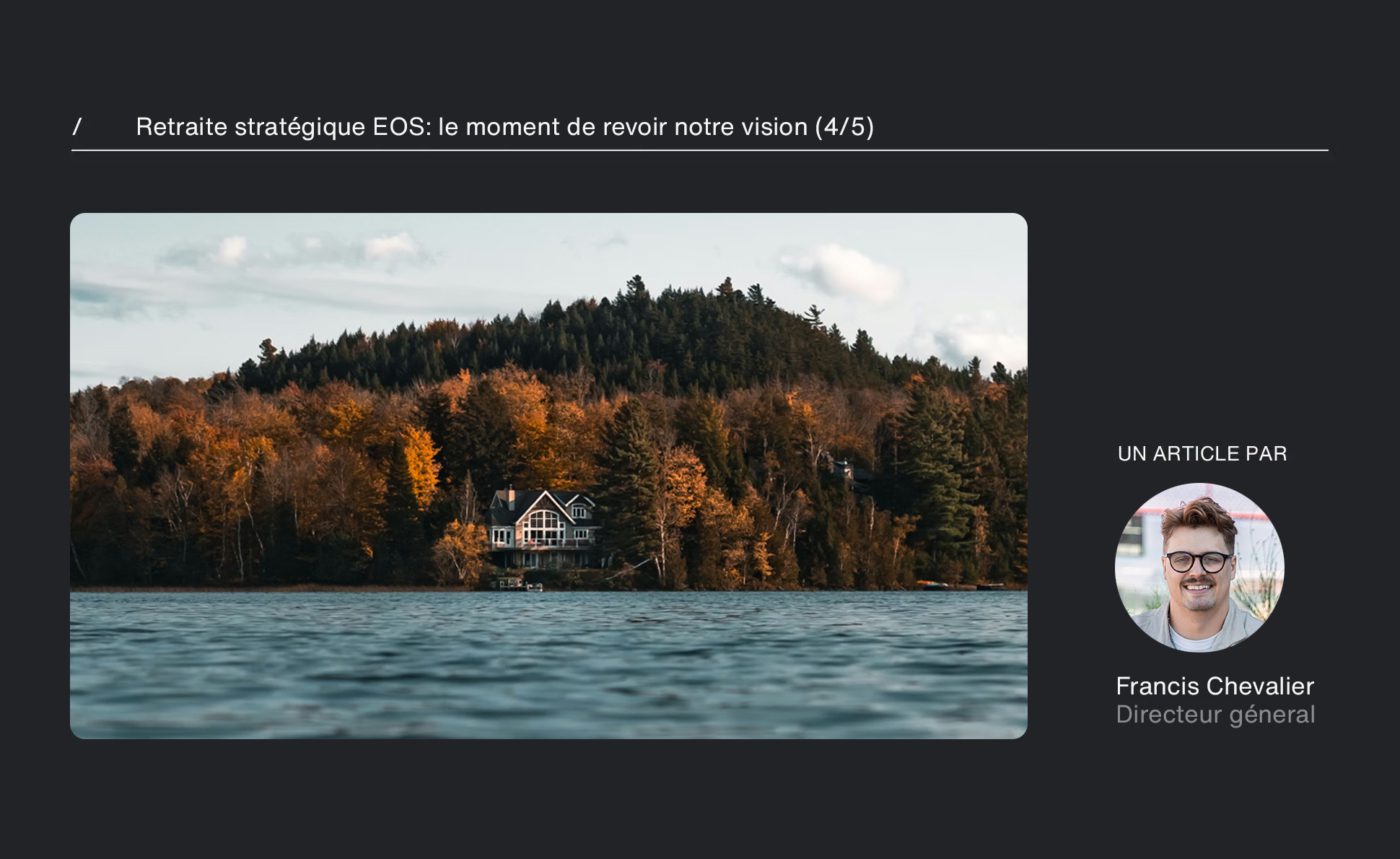
One year after implementing EOS at TREIZE, we gathered at a chalet for a day and a half to revisit our V/TO from top to bottom. It was our first annual meeting in the EOS format, and we did not really know what to expect. What we experienced was at once more intense, richer, and more imperfect than we had anticipated—and that is exactly why it was worth it.
The annual EOS meeting, on paper—what does it look like?
To understand what we did, you first need to understand what the EOS framework proposes as a baseline format. In the EOS (Entrepreneurial Operating System), the annual meeting is a two-day strategic pause reserved for the leadership team. The goal: step out of operational mode to gain perspective, revisit the long-term vision, plan the year ahead, and define short-term priorities.
The standard agenda is split into two main blocks:
- First, you revisit the Vision part of the V/TO (Vision/Traction Organizer): the company values, the 10-year target, the niche or positioning, the SWOT analysis, and the 3-Year Picture (a concrete projection of what the company looks like in three years).
- Then, you dive into the Traction part: the one-year plan, concrete goals, the next quarter’s rocks, and resolving the strategic issues that have been identified and not yet addressed.
In theory, the whole thing is facilitated by an external facilitator, and the team arrives having completed individual prep work. It is a tight, structured format designed to produce clear decisions and lasting alignment.
At TREIZE, we used that foundation. But we did things our way.
Why we invited the whole team to the annual meeting
From the start of our EOS implementation, we made a decision that departs from the manual: involve the whole team, not just managers. Level 10 meetings, rocks, and values—everything was experienced collectively at TREIZE. It would have been inconsistent to run our first annual meeting any other way.
So we rented a chalet for the week, and set aside Thursday and Friday morning for the V/TO meeting. The whole team was there—developers, project managers, designers, everyone.
The team arrived with a lot of enthusiasm, a bit of excitement about doing a real strategic retreat, and also several questions: how is this going to work? are we really going to question everything? There was genuine curiosity—a feeling of taking part in something that mattered.
A day and a half to go through the V/TO, point by point
We decided to follow the classic order of the annual meeting, section by section, without changing it too much. The approach: question everything, challenge ourselves on every point, and take nothing for granted.
Thursday was devoted to the Vision part. We started with values, and that is where it took time. Asking ourselves what really gets us out of bed in the morning and what is non-negotiable in how we work may seem simple on the surface, but in a group, with varied perspectives, it generates much deeper discussions. We debated at length. And in the end, we changed nothing. . Our values held up under scrutiny, and that in itself is valuable information.
The group exercise that surprised us the most was the SWOT analysis. Strengths we had underestimated rose to the surface. Threats that some people saw clearly were not on others’ radar at all. The SWOT created a shared lens we did not have before. Several issues that had been lingering without being named were put on the table, and that is where we were able to start addressing them.
Once the values were confirmed, the 10-year vision clarified, and the niche specified, the rest flowed naturally. The 3-Year Picture, the one-year plan, the rocks—these exercises no longer felt as theoretical. They followed logically from what we had just built together.
By Friday morning, we were ready for the Traction part: the one-year plan, the remaining issues, and defining the rocks for the first quarter. Having aligned everything the day before made these decisions much easier to make. The small glass of wine on Thursday night and a good night’s sleep probably also helped our subconscious work on these topics.
Where the annual meeting really paid off: traction
On paper, the V/TO itself was not completely transformed. A few adjustments, a few clarifications, but no 180-degree turn. You could conclude that the meeting did not have a major impact.
That would miss what really happened.
We felt the most tangible impact in the weeks that followed: our rocks were better aligned with our annual goals. Not because we followed a better template, but because the whole team had taken part in building the plan. Everyone understood why a given priority had been chosen, what it was for, and how it fit into the broader vision.
What we noticed is that we drifted less. Interesting ideas kept emerging, as always in an agency full of brains full of ideas, but we now had a clear framework to assess whether it was worth pursuing now or putting on hold. The V/TO had become a filter through which we measured our innovative ideas.
Collective alignment is hard to measure directly. But you feel it in the consistency of decisions, in how people prioritize their work, and in the ability to say no without having to explain at length why.
What we would do again, what we would change
In hindsight, we can clearly see what worked well and what we would benefit from adjusting.
What we would do again without hesitation. A day and a half was well suited to the size and makeup of our team. The chalet had exactly the intended effect: getting out of the usual context and creating a bubble where strategy took center stage. And including the whole team generated an alignment and ownership of the V/TO that we would not have had otherwise.
What worked less well. We arrived without a specific angle, in “we question everything and see what comes out” mode. For a first annual meeting, it was a bit too open-ended. Questioning the values, the 10-year vision, the niche—everything at the same time and with everyone—generates a lot of discussion, but not always the most focused. At times, we went in circles before finding the right question to ask.
What we decided to adjust for the following years. We decided not to challenge everything the same way every year. Instead, we now give ourselves a theme or a direction for each annual meeting—an axis we dig into more deeply—rather than going through everything in free-reflection mode. It allowed us to create real workshops and targeted exercises, rather than simply gathering around a table to “chat about the V/TO.”
The role of internal facilitator also has its limits. The integrator who facilitates may also have opinions on the substance. Staying in listening mode when you want to contribute to the discussion is a constant balancing act. By incorporating more workshops and exercises than discussions, there was naturally less mediation to do.
The first time was not perfect for us, but that is normal. What mattered was creating the ritual—stepping out of the day-to-day once a year to look at the agency from above, together. It allowed us to complete a first full EOS cycle, and it reinforced the relevance of this system in our daily work. We see it in the quality of the rocks, in the clarity of decisions, and in the consistency of priorities month after month.
This article series is about EOS, the Entrepreneurial Operating System. We invite you to dive in with us on our journey implementing EOS at TREIZE. Through these articles, we will share not only the key EOS concepts, but above all our concrete experience, our standout successes, and the challenges we encountered along the way.