

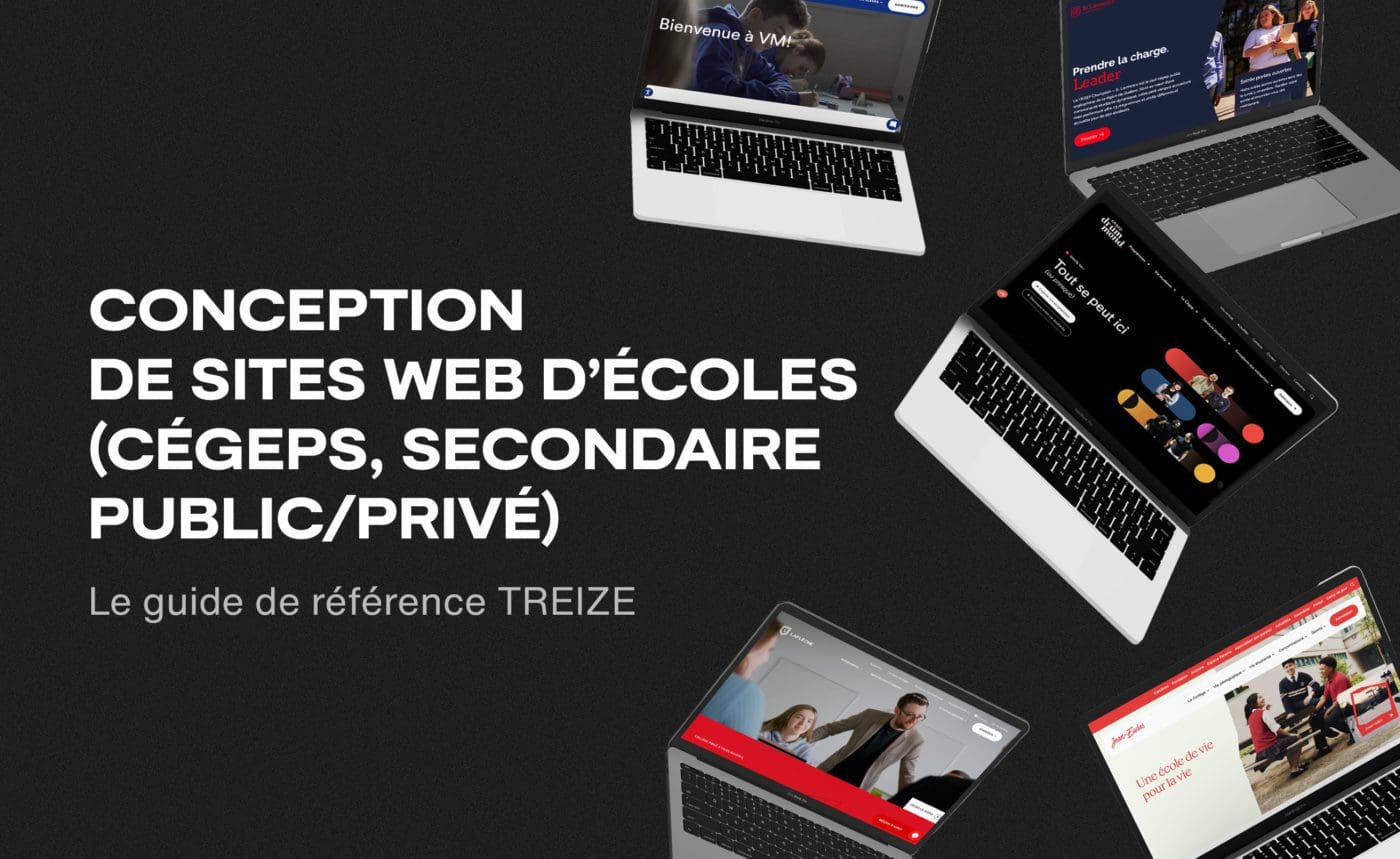
Educational institution websites are no longer simple, static “web brochures.” Today, they are the digital heart of the establishment: tools for recruitment, orientation, communication, and operations. They must assist many different targets (prospective students, parents, current students, alumni, employees, partners) while meeting complex regulatory, accessibility, and integration constraints.
Through more than a dozen mandates in the world of education, we have built a specialized approach, proven with numerous CEGEPs, colleges, and high schools, allowing our clients to:
- Improve conversion (increase in admission applications, registrations, or open house participation).
- Reduce informational friction for current students and parents.
- Optimize the discoverability and accessibility of their educational offering.
In this article, you will find our recipe for delivering school websites that are well-thought-out and effective.
1) Discovery and strategy phase
Understanding the different targets
The success of a school website is first determined by the modeling of user journeys. An educational institution does not have a single target audience, but several audiences with different expectations and needs. This is the most important challenge to overcome.
Using collaborative workshops, we begin by mapping the critical steps and friction points for each persona, then transpose them into clear, guided, and measurable web journeys. As an indication, we generally find these personas on a college website:
- Prospective students: they need concise information about programs, decision-making support (interest tests, “student for a day” programs), and a simple admission process.
- Current students: they look for quick links to platforms (Omnivox, Moodle, email), course schedules, student services, and important updates.
- Parents/tutors: they require information on safety, costs, support services, and communication procedures with the school. They also play an important role in their child’s choice of program. They must therefore be reassured and convinced that the institution will offer the support and format that best suits their needs.
- Alumni: they are interested in foundation events, job offers, and maintaining a connection with the institution.
- Staff and future employees (Human Resources): they consult job offers and access the intranet or internal tools.
To cite just one scenario, the admission journey for an international student differs from that of a resident Canadian student. This challenge complicates the structure and information that must be found on a pillar page of the website: the admission process.
O’Sullivan College, our client since 2023, handles these different profiles well to segment information specific to each student profile, while maintaining a simple and concise interface and structure. For prospective students, personalized guidance is necessary to direct them toward a choice that is right and adapted to their needs. It is therefore essential to simply categorize the multiple choices available to them.

Clarifying the key steps of the academic journey
Key moments of school life must be highlighted and optimized. The website is a powerful conversion tool for these crucial steps. Before reaching the admission application, several elements can be put in place to provide maximum information and reassure the prospective student and their parent that the establishment is right for them.
Information about open houses, the possibility of taking a virtual tour, access to student testimonials, or the ability to chat with a human or a chatbot should be considered in the strategic reflection.
Answering the right question at the right time
The choice of a study program, for example, is a major decision for our users, and it is important to guide them well and ensure there is an answer for the user, no matter where they are on the website. We must put ourselves in the student’s shoes and know what questions they will ask at a specific location on the website. Then, we must ensure the answer is accessible at that location.
Thus, for a prospective student who wishes to consult all the programs offered by the CEGEP near them, it is important to offer an organized catalog and information at the first level, to avoid overcomplicating things and causing them to leave rather than dig deeper.
For example, Cégep de Drummondville, which offers more than thirty programs, presents a catalog with cumulative filters. Prospective students can filter by interest (IT, health, arts), type (DEC, technical), and status (online, limited enrollment), guiding them toward a choice that is right and adapted. Then, on program pages, such as those of Champlain College, the header gathers all essential information at a glance (duration, admission session, course number, type of path), which facilitates quick understanding.
In contrast, for high schools, the choice of concentration must often be more oriented toward passions and what excites young people. Collège Ville-Marie, which addresses prospective high school students, offers a fun quiz to guide prospective students in choosing their program based on their interests and passions. For its part, Collège Jean-Eudes highlights categories of passions for young people.

2) Design phase
Bringing the student experience to life
The choice of an institution is often emotional. A website must inspire and allow the prospective student to project themselves into their new environment. We regularly recommend the use of videos, photos, and real testimonials to capture users’ emotions.
On the Collège Jean-Eudes website, we focused on a strong visual approach to humanize the experience and provide a glimpse of the campuses, while reinforcing the attractiveness of the programs. A virtual tour of the facilities also becomes persuasive content for users. This type of content helps with projection and the feeling of belonging to the institution even before studying there.
3) Integration and development phase
A school institution website must be much more than a showcase: it is a dynamic management tool capable of adapting to changes in the educational environment and the needs of its multiple users. This requirement calls for a robust and flexible web architecture.
Scalable architecture and reusable blocks
The educational offering, services, and teams of a school institution are constantly evolving. New programs are created, changes in schedules or services are announced, and events are added. Your website must not become a brake on your dynamism.
To ensure that websites always stay up to date without depending on your web agency, we build websites from custom, reusable content blocks in which content is dynamic. This approach guarantees three fundamental benefits:
- Autonomy: thanks to training and simple administration, adding or modifying pages or sections is possible without having to touch any code.
- Consistency: the use of a block system ensures that new pages created by your team will respect the visual identity and web best practices.
- Sustainability: built on a modular base, the website is easier to maintain, update, and evolve to integrate new future functionalities.
Effective communication, even in emergencies
Schools must regularly communicate urgent information that affects the community’s daily life: class cancellations, unexpected closures due to bad weather, important reminders for the registration period, etc. These messages must be clear and, above all, accessible.
To do this, we integrate optimized and adaptive display mechanisms. For example, an alert banner that can be activated for a specific period. It can be customized (color, size, etc.) and link to a dedicated page, ensuring that critical information is the first thing the visitor sees.
On the home page, it is also possible to centralize news using a dedicated section, without overwhelming the user. O’Sullivan College uses this on the website’s front page.

Integration of your educational tools
A school website is not a silo. It is a gateway to essential management and learning tools. Successful integration between all the platforms you use is paramount for a successful user journey. We ensure fluid and secure integration with the most common tools in the education sector, such as Omnivox, Pluriportail, Moodle, Brightspace, and many others.
The SEO (Search Engine Optimization) contribution that these redirection links bring to the website should not be overlooked either. Optimizing program pages with rich snippets, coupled with the integration of recognized industry tools, reinforces your website’s positioning as a credible and complete source of information for queries like “Omnivox CEGEP X” or “Technical Programs Y.”
Compliance with digital accessibility standards
In the public and parapublic sectors, accessibility is not an option; it is a legal and ethical requirement. We take the time to design school institution websites by strictly respecting the Standard on Website Accessibility (SGQRI 008 3.0) and international WCAG 2.2 (Level AA) standards. This includes, among others:
- Semantic structure and clear navigation: Using correct semantic HTML (hierarchical headings, lists), offering consistent navigation, and allowing full keyboard access.
- Perceptible content for all: Providing text alternatives for images, captions for videos, and ensuring that information never relies solely on color or visuals.
- Readability and sufficient contrast: Respecting contrast ratios (AA), allowing text resizing without loss of content, and avoiding blocks of text that are difficult to read.
- Accessible and understandable forms: Correctly associating labels and fields, providing clear error messages, explicit instructions, and input assistance.
- Compatibility with assistive technologies: Testing with screen readers, ensuring correct focus management, and using ARIA attributes only when necessary.
4) Search Engine Optimization (SEO) phase
A school institution website is generally in competition with many other websites. It is therefore essential to apply best practices in terms of organic search ranking, both for the container and the content.
In addition to building the website on a structure that meets all technical SEO requirements, our team is equipped to support you in everything related to content. In most cases, we are responsible for providing you with a complete sitemap and page zoning, so that you can handle the content writing on your end. Once you have written everything, we analyze your work and make recommendations to ensure we have texts optimized for search engines, without neglecting user readability.
Expertise dedicated to the education sector
Designing a website for an educational institution is a major project that requires specialized expertise, from modeling user journeys to integrating complex systems.
At TREIZE, we don’t just build sites; we build digital platforms that allow CEGEPs, colleges, and high schools to significantly increase their admission conversion rates and optimize their user experience, while ensuring compliance with accessibility and security standards.
Do you think a collaboration between us could be interesting? Do not hesitate to complete a quote request; we would be happy to discuss it with you.
If you would like to learn more about our way of working or if you would like to see projects we have completed, here are some case studies of school projects we have worked on in recent years:


